
RUMA CARE
✢ Built for rheumatology
Biologics access
made easy
Biologics access
made easy
Made by people who work inside infusion clinics

✢ How it works
✢ How it works
✢ How it works
We help you streamline your…
Prior authorizations
Prior Authorizations
Ruma automatically pulls required information from your EHR, extracts the data needed for your patient’s specific diagnoses and insurance, and generates a full and accurate form for submission.
Copays
Copays
Your patients shouldn’t need to pay out of pocket and your staff shouldn't need to remember which portal to use for copay enrollment programs. We use your EHR-integrated data to automatically find and enroll your patients in the right copay assistance programs.
Reimbursements
Reimbursements
Ruma helps you stay ahead of denials and reimbursement issues so every infusion gets paid correctly. Never go underwater again with your buy-and-bills.
01
Fill out prior auth forms with the click of a button
Ruma automatically pulls patient, provider, and payer data to complete prior authorization forms in seconds.
02
Everything in one platform
No more juggling between web portals, fax, and paper forms
03
Designed for infusion clinics
Ruma helps you stay ahead of denials and reimbursement issues so every infusion gets paid correctly. Never go underwater again.
From teams who've built at…


"Ruma Care helps us get our prior authorizations done so fast, we have time to play"


Janeen Thompson
San Mateo Rheumatology
Frequently Asked Questions
How are prior authorizations for biologics different?
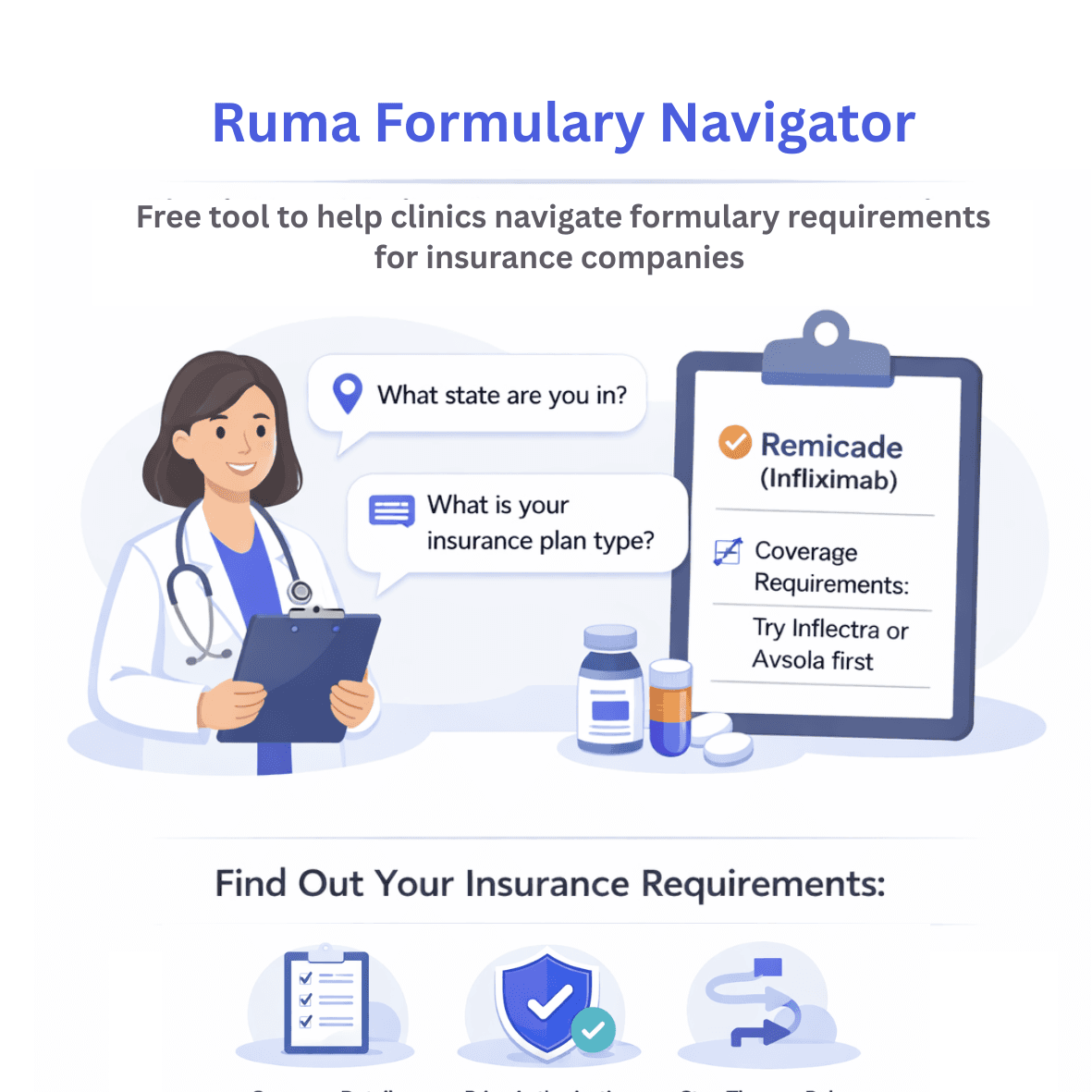
Biologics PA are far more complex than PA for standard medications. Payers typically require step-therapy history, recent labs or imaging, and weight-based dosing details before approval. Some biologics run through the pharmacy benefit (self-injectables), while many are billed under the medical benefit (infusions), forcing clinics to navigate through separate portals. Because of these stricter requirements, biologic prior authorizations see much higher denial and delay rates than traditional drug PAs — adding significant burden for providers and patients.
What makes RUMA different from CoverMyMeds or other ePA platforms?
To add an image, select any Frame, and either double-click on it, or go to the Fill property. In the Fill property, switch to the image icon. Here, you can upload images.
How do you reduce denials compared to other PA tools?
RUMA ensures submissions are payer-ready the first time by auto-populating forms with clinical details, attaching the right documentation, and flagging gaps before they’re sent. Providers spend less time reworking cases, and patients start therapy faster with far fewer denials.
Can you handle both medical and pharmacy benefit prior authorizations?
CoverMyMeds digitized pharmacy benefit prior authorizations, but it wasn’t built for biologics or medical infusions. Even with ePA platforms, 20–40% of biologic requests are still denied on first submission because the tools simply move forms. RUMA is the first biologics-first platform that unifies both medical and pharmacy benefit workflows in one place. We go beyond form delivery by assembling complete PA packets, auto-attaching the right labs and therapy history, and flagging gaps before submission — giving providers a much higher chance of approval the first time.
How do you protect patient data?
We are HIPAA-compliant and use enterprise-grade security protocols, including encryption at rest and in transit, strict role-based access controls, and audit logging. Patient data is never shared with payers, pharma, or third parties without explicit authorization — and all analytics we provide are de-identified and aggregated.
How are prior authorizations for biologics different?
Biologics PA are far more complex than PA for standard medications. Payers typically require step-therapy history, recent labs or imaging, and weight-based dosing details before approval. Some biologics run through the pharmacy benefit (self-injectables), while many are billed under the medical benefit (infusions), forcing clinics to navigate through separate portals. Because of these stricter requirements, biologic prior authorizations see much higher denial and delay rates than traditional drug PAs — adding significant burden for providers and patients.
What makes RUMA different from CoverMyMeds or other ePA platforms?
To add an image, select any Frame, and either double-click on it, or go to the Fill property. In the Fill property, switch to the image icon. Here, you can upload images.
How do you reduce denials compared to other PA tools?
RUMA ensures submissions are payer-ready the first time by auto-populating forms with clinical details, attaching the right documentation, and flagging gaps before they’re sent. Providers spend less time reworking cases, and patients start therapy faster with far fewer denials.
Can you handle both medical and pharmacy benefit prior authorizations?
CoverMyMeds digitized pharmacy benefit prior authorizations, but it wasn’t built for biologics or medical infusions. Even with ePA platforms, 20–40% of biologic requests are still denied on first submission because the tools simply move forms. RUMA is the first biologics-first platform that unifies both medical and pharmacy benefit workflows in one place. We go beyond form delivery by assembling complete PA packets, auto-attaching the right labs and therapy history, and flagging gaps before submission — giving providers a much higher chance of approval the first time.
How do you protect patient data?
We are HIPAA-compliant and use enterprise-grade security protocols, including encryption at rest and in transit, strict role-based access controls, and audit logging. Patient data is never shared with payers, pharma, or third parties without explicit authorization — and all analytics we provide are de-identified and aggregated.
How are prior authorizations for biologics different?
Biologics PA are far more complex than PA for standard medications. Payers typically require step-therapy history, recent labs or imaging, and weight-based dosing details before approval. Some biologics run through the pharmacy benefit (self-injectables), while many are billed under the medical benefit (infusions), forcing clinics to navigate through separate portals. Because of these stricter requirements, biologic prior authorizations see much higher denial and delay rates than traditional drug PAs — adding significant burden for providers and patients.
What makes RUMA different from CoverMyMeds or other ePA platforms?
To add an image, select any Frame, and either double-click on it, or go to the Fill property. In the Fill property, switch to the image icon. Here, you can upload images.
How do you reduce denials compared to other PA tools?
RUMA ensures submissions are payer-ready the first time by auto-populating forms with clinical details, attaching the right documentation, and flagging gaps before they’re sent. Providers spend less time reworking cases, and patients start therapy faster with far fewer denials.
Can you handle both medical and pharmacy benefit prior authorizations?
CoverMyMeds digitized pharmacy benefit prior authorizations, but it wasn’t built for biologics or medical infusions. Even with ePA platforms, 20–40% of biologic requests are still denied on first submission because the tools simply move forms. RUMA is the first biologics-first platform that unifies both medical and pharmacy benefit workflows in one place. We go beyond form delivery by assembling complete PA packets, auto-attaching the right labs and therapy history, and flagging gaps before submission — giving providers a much higher chance of approval the first time.
How do you protect patient data?
We are HIPAA-compliant and use enterprise-grade security protocols, including encryption at rest and in transit, strict role-based access controls, and audit logging. Patient data is never shared with payers, pharma, or third parties without explicit authorization — and all analytics we provide are de-identified and aggregated.